Bosques del Mañana
01/05/23
Two years converting degraded and deforested land into forest in Nicaragua
Reforestation, in general terms, can be defined as the set of activities that include planning, logistics, operation, controls and supervision of all the processes involved in planting trees. In practical and technical terms, each of the activities that involve reforestation is full of complex sub-activities, dozens of people trained to face each of the challenges, unexpected events, last-minute changes, decisions that must be taken at high speed, and above all, a lot of commitment and motivation. Force majeure events such as extreme rains and droughts intensified by climate change can make it harder.
The project “Bosques del Mañana” is part of the Global Reforestation Program of Nestlé commitment to reduce its carbon footprint. In Nicaragua the project will plant 8.6 million trees in a period of 6 years and hired ECOM Nicaragua as a project developer.
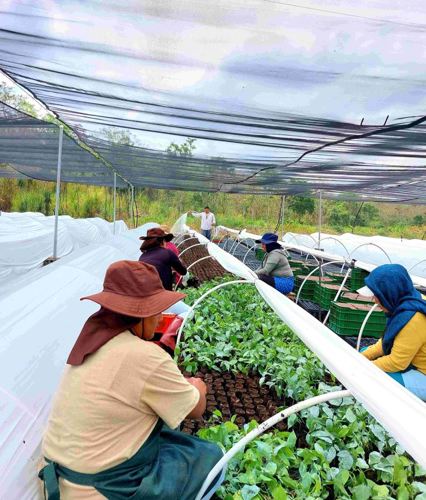
Reforestation, restoration and environment
During 2021 and 2022, the project already planted 1.3 million trees in degraded areas of farms of coffee and milk producers. For 2023, 1.2 million trees are planned to be planted. Trees are planted in areas where soil degradation has been so intensive that it is practically impossible to recover the forest by natural regeneration.
SMS technicians, logistic and administrative team has managed to overcome barriers and every day challenges. The accompaniment, monitoring and supervision in the field of more than 630 producers participating in the project has shown a low desertion of producers and high tree survival rate.
In order to monitor biodiversity progress of the project, ECOM Nicaragua hired Cornell Ornithology Lab to train young students from the communities where project is been implemented in order to raise awareness that the trees planted will help increase the richness of the birds in the area and that they themselves can participate in measuring this change through the use of the iBird platform to monitor the improvement in biodiversity.
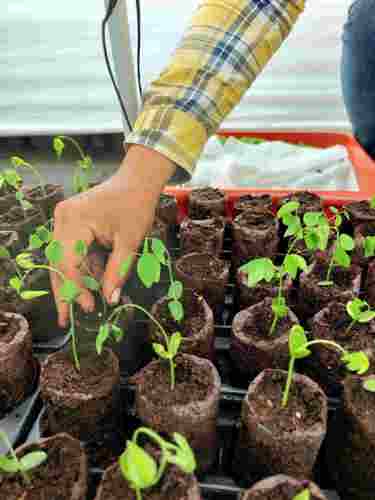
Nursery and technology: An opportunity for the forests of Nicaragua and the mitigation of the impacts of climate change
Through the project, the nursery of ECOM Nicaragua had increased its technological capacity using biodegradable substrate (Ellepot) to avoid the use of plastic bags. The trees are transported from the nursery to the farms in boxes made with the wood coming from the thinning of SMS managed farms, contributing to reducing the carbon footprint of the project. The Ellepot technology used represents many advantages: faster and healthier root development, shorter production cycles, greater uniformity in plantation, easier and faster transplant, and automation of the process using the Ellepot machines to produce it.
Certain species of trees are being multiplied through the technology of vegetative propagation through cuttings to improve their physiological quality and growth in the field without depending on seed sources that are less available every day due to climate change. The techniques used in the Nursery have shown to produce trees that are more resistant to tropical soil conditions: high compacted soils with lack of drainage during the rain season and with lack of water in the summer season. La Cumplida nursery, during the peak of production, hires more than 100 temporary collaborators, being a source of income for families from the surrounding communities.
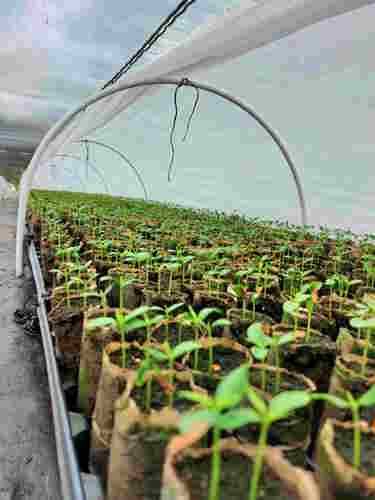
Biodiversity and the protection of endangered species: Among the tree species produced in the Nursery there is the almond tree (Amygdalus communis), which is home to the scarlet macaw (Ara macao), a specie that is currently on the IUCN Red List of Threatened Species. Almond trees also contribute to improving the connectivity between biological corridors and protected areas.
The success of the project has depended to a large extent on ECOM’s talent, and the large propagation capacity of the nursery previously installed. This project represents an unprecedented contribution to the ecology of Nicaragua, to the mitigation of the impacts of climate change and to the conservation of biodiversity through the training of future generations in the care of the environment.
Reference:
Interviews with Project staff.
More news
News
Click to read this articleAcquistion of Universal Commodities (Tea) Trading, Inc. to the ECOM Group
We are pleased to announce that Universal Commodities (Tea) Trading (UCTT), will be joining the ECOM Group, marking an important step in expanding its global soft commodities platform and establishing its presence in the tea sector.
News
Click to read this articleSilent Brew, Strong Voices Project Updates
Following the SCTA Next Gen's Sustainability Award for our project 'Silent Brew, Strong Voices', we're proud to share an update on the impact this project is having in Pu'er, China.
News
Click to read this articleShaping a more resilient future for U.S. Cotton – 2026 ACSA Annual Convention
ECOM recently participated in the 2026 American Cotton Shippers Association (ACSA) Annual Convention, one of the U.S. cotton industry's key annual gatherings.
News
Click to read this article2025 Cocoa Sustainability Report
We are pleased to share the release of our 2025 Cocoa Sustainability Report, highlighting the progress made across cocoa supply chain over the past year.
News
Click to read this articleECOM and Nestlé inaugurate two new schools in Ghana
We recently partnered with Nestlé to inaugurate two new schools in the Adarkwa and Akroma communities in Ghana, as part of the Nestlé Cocoa Plan. The new schools aim to improve access to quality education and create safer, more supportive learning environments for children in cocoa-growing communities.
News
Click to read this articleECOM Village Brussels
ECOM Village was pleased to return to the World of Coffee, which took place in Brussels last month.
News
Click to read this articleCocoa Week 2026
Last month, during London Cocoa Week, ECOM had the pleasure of hosting a drinks reception at the Tower of London, bringing together colleagues, partners, and industry peers for an evening of connection and exchange.
News
Click to read this articleConnecting through coffee: A dialogue between Vietnam and China
The 2nd Jade Dragon Snow Mountain Coffee Week was recently held in Lijiang, China, bringing together coffee professionals, industry experts, cultural envoys, and tourism delegates from Vietnam and China. The event created a platform for exchange between two important Asian coffee origins, highlighting coffee’s role not only as a traded commodity, but also as a bridge for cultural dialogue, technical knowledge-sharing, and regional collaboration.
News
Click to read this articleA week of collaboration and exchange between South American cocoa origins
ECOM managers from Peru and Ecuador recently came together in Mexico for a week focused on strengthening collaboration, sharing knowledge, and continuing to support the development of ECOM’s coffee and cocoa operations across the region.